Concrete sidewalk contractors in Spring Hill: walks to the front door, along the side yard, across the strip
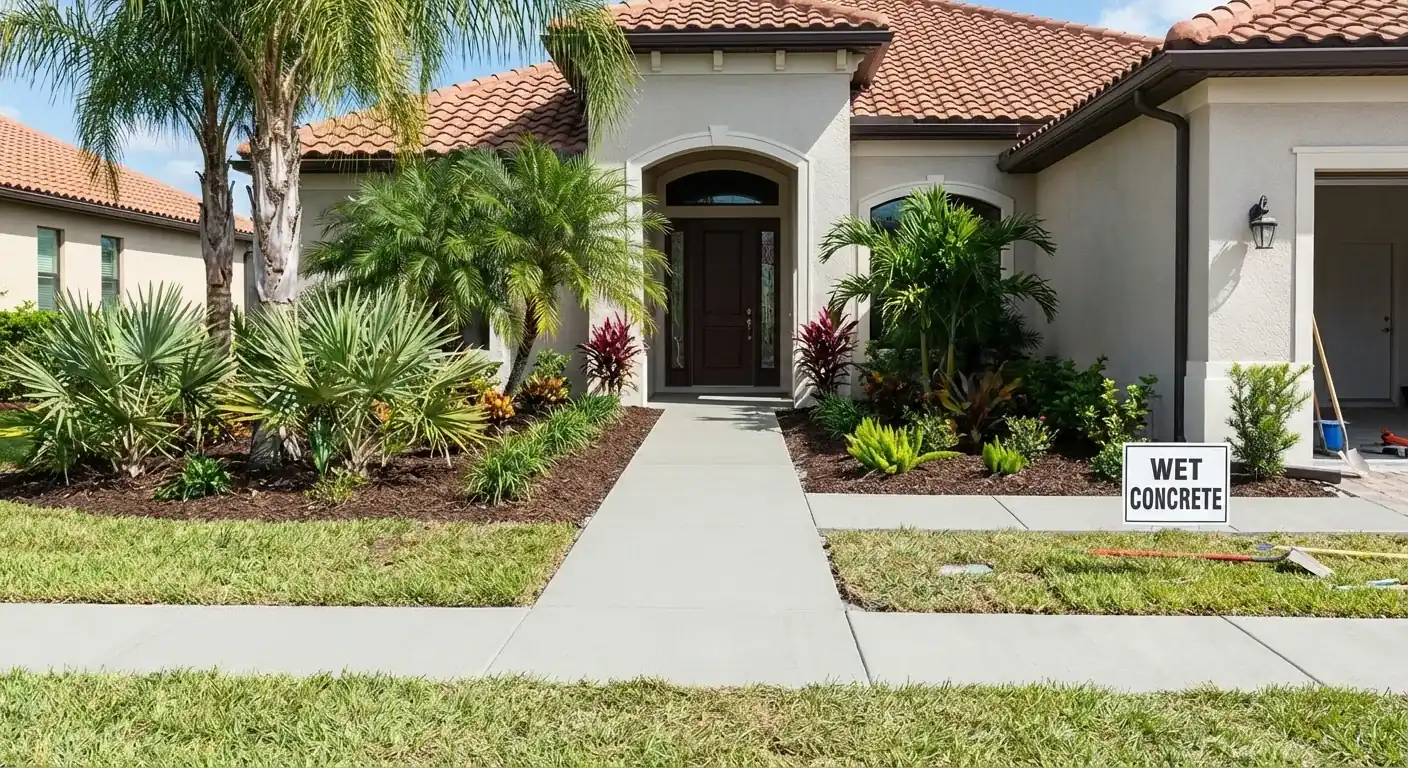
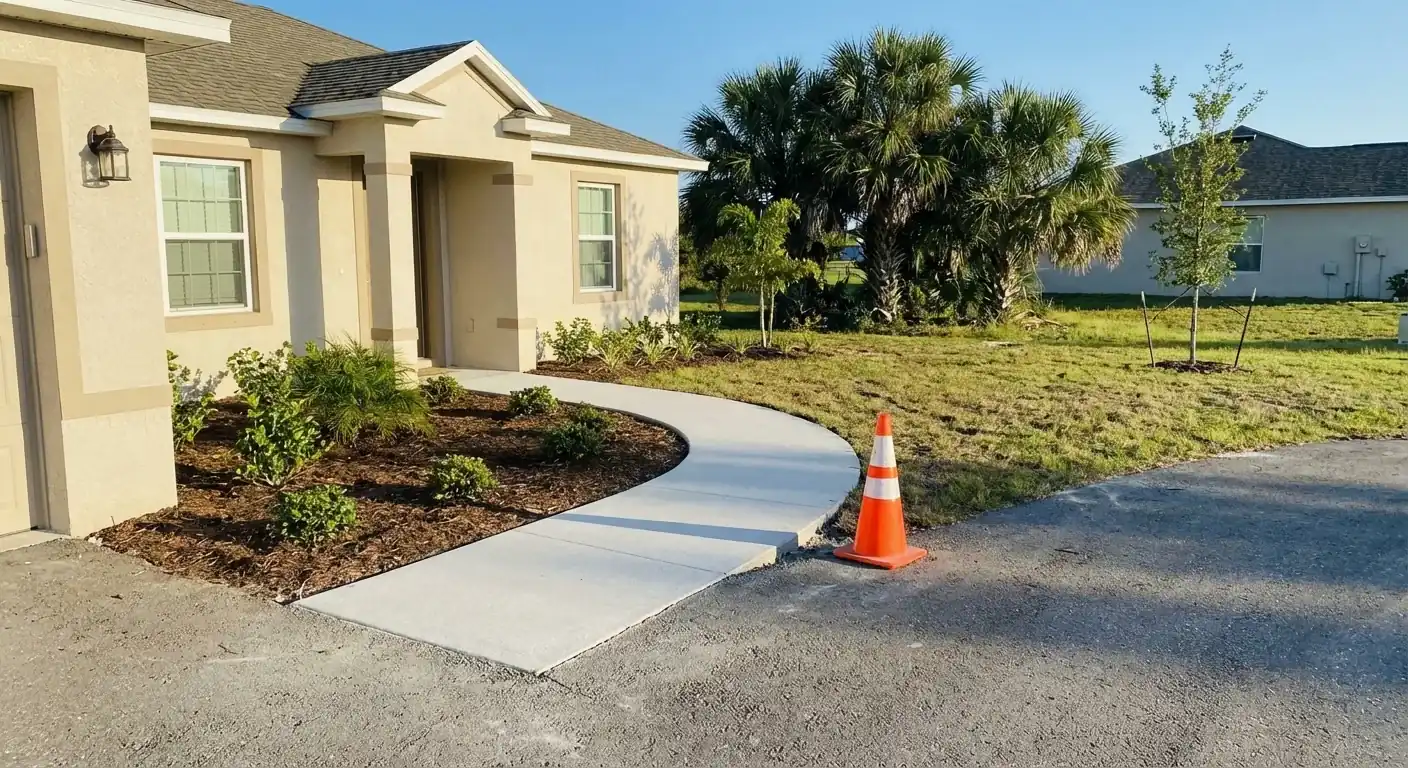
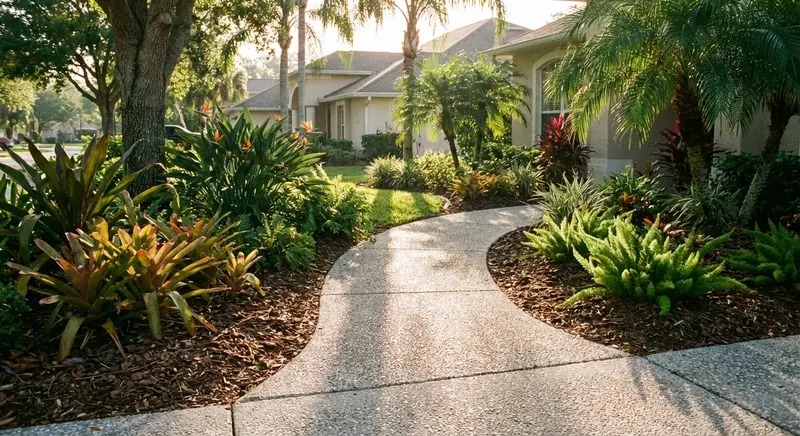
Sidewalk jobs in Spring Hill sort into three groups. One is the front walk from the driveway or street to the door. In the original Deltona-platted Spring Hill units the median house was built in 1987 on a lot of about a quarter acre, so an original walk has had decades of roots, sprinklers and summer storms. Another is the side-yard or backyard path to a gate, an equipment pad or a garden bed. The last is a sidewalk in the public right of way, where the county or a city sets the rules.
As concrete sidewalk contractors in Spring Hill we pour all three from 4 inches thick, at $8 to $14 per sq ft with a free written estimate after we see the site. When a walk meets a concrete driveway or a patio slab, we plan both pours together so the joints line up. Got an old walk that's only cracked? Our concrete repair and resurfacing visit tells you whether it needs replacing at all.
Why a county sidewalk is 5 feet wide and 6 inches thick, and a home walk is not
Hernando County's 2026 engineering guidelines spell out a public sidewalk: 3,000 psi concrete, at least 5 feet wide and 6 inches thick, with the subbase compacted to 95 percent. Across a driveway it adds 6 by 6 #10 wire mesh or commercial fiber mesh. That is a standard for public sidewalks and does not cover the private walkway to your front door, so a home walk's width and thickness are your decision.
We price a home walk at 4 inches thick and 4 feet wide, enough for two people side by side. Go to 5 feet if it joins a county sidewalk. A side-yard path can drop to 3 feet where the gap beside the house is tight. Width changes the bill because the bill is square feet: a 50 foot walk is 200 sq ft at 4 feet wide and 250 sq ft at 5 feet, which is $2,000 to $3,500 at $8 to $14. Anything a car, trash truck or mower trailer will cross gets thicker concrete and steel, quoted like driveway concrete.
Our walkway range is $8 to $14 per sq ft for 4 inch concrete at 4 feet wide. A typical project of about 200 to 300 sq ft runs $1,600 to $4,200.
| Job | Per sq ft | Typical project | What moves the price |
|---|---|---|---|
| Front walk, 4 ft wide, broom finish | $8 to $14 | 200 sq ft: $1,600 to $2,800 | Length, curves, tear-out of the old walk |
| Longer or wider walk | $8 to $14 | 300 sq ft: $2,400 to $4,200 | Width, truck access, mesh near roots |
| Short path or side-yard run | $8 to $14 | Priced at a job minimum | Short runs hit a minimum, not a square-foot price |
| Stamped or colored walk | $12 to $22 | Quoted after the visit | Pattern, color and sealer |
Every number is a range until we see the site. You get a free written estimate with the size, thickness, steel, joints and any permit step before work begins.
Joint spacing, fiber and mesh: where a long narrow walk is meant to crack
Concrete shrinks as it cures, so we put joints where we want it to crack. Hernando's public sidewalk detail puts a joint every 5 feet and a 1/2 inch expansion joint every 50 feet. On a 4 foot home walk we lay panels out close to square, a joint about every 4 to 5 feet, with an expansion joint wherever the walk touches the house, a step, a driveway or a curb. The Concrete Network's driveway guide says to cut control joints to one-fourth of the slab depth, 1 inch in a 4 inch slab.
The reinforcement goes in the estimate by name. NRMCA's CIP 24 says synthetic fibers reduce plastic shrinkage and settlement cracking but should not stand in for thickness or joint spacing. So a plain home walk gets fiber, and a walk that crosses a driveway or runs close to a tree gets mesh. A crack along a joint line means the plan worked. One wandering across the middle of a panel tells you something under the slab is moving.